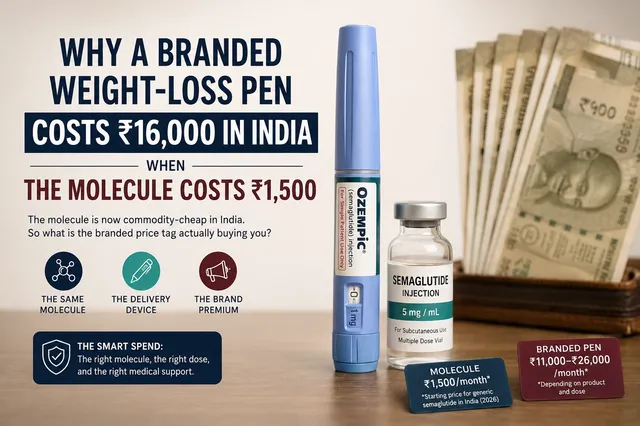
Ozempic Price in India 2026 — and the ₹5,999 Alternative Your Doctor Can Prescribe Today
For two years Ozempic was the drug everyone wanted and almost nobody could reliably get. That changed in March 2026. Here's what it actually costs now, why the brand name was never the point, and the cheaper, legal, same-molecule route most patients should be on.
ALTRcare Medical Team
Clinical Editorial
If you searched Ozempic price India any time before this year, the number that came back was frightening: ₹18,000 to ₹22,000 a month, and that was if you could find it. That figure was real — but it described a grey market, not a pharmacy shelf. Ozempic wasn't officially sold in India then. People imported pens, paid import margins on an already premium drug, and accepted that supply could vanish for weeks.
That era is over. And the new numbers change the entire calculation for anyone considering a GLP-1 for weight loss.
What Ozempic actually costs in India in 2026
Ozempic launched officially in India in December 2025. After Novo Nordisk's April 2026 price cut, the starting 0.25 mg dose costs around ₹5,660 a month. But almost nobody stays on the starting dose — it exists only to let your body adjust. As you titrate up to a maintenance dose, the monthly cost climbs to roughly ₹8,000–₹16,000 depending on strength.
So the honest answer to “what does Ozempic cost in India” is: less than the scary import numbers you remember, but still ₹1–1.6 lakh a year for the drug alone at a real maintenance dose — before a single consultation, blood test, or follow-up.
Ozempic vs Wegovy
Ozempic is approved in India for Type 2 diabetes. The semaglutide product approved for obesity is Wegovy — the same molecule, a different label, often a different price.
Why it kept going out of stock
The stockouts weren't a glitch — they were structural. Global demand outstripped manufacturing for years, and India, a smaller and lower-priced market, sat near the back of the supply queue. When you buy an imported pen through informal channels, a shipment delay in another country becomes your missed dose here.
Even now that Ozempic is officially distributed, two frictions remain: brand supply can still tighten when global demand spikes, and the cost of escalating to a full dose makes long-term adherence expensive. For a treatment that only works while you take it, an erratic or unaffordable supply isn't a minor inconvenience — it's a treatment failure waiting to happen.
Not sure where to start?
Take the free 2-minute assessment. A doctor reviews it and tells you what's appropriate — no obligation, no brand mark-up.
Semaglutide is a molecule, not a brand
Here is the single most useful thing to understand before you spend a rupee. Semaglutide is the active molecule — a GLP-1 receptor agonist that slows how fast your stomach empties, blunts appetite, and quiets the food-noise that drives overeating. Novo Nordisk discovered it and sells it under two brand names: Ozempic (for diabetes) and Wegovy (for weight management). Same molecule, different doses, different boxes, very different prices.
You are not paying ₹16,000 a month for a superior chemical. You're paying for a brand and a patent. The drug working inside your body is semaglutide either way.

March 20, 2026: the patent expired
On 20 March 2026, Novo Nordisk's semaglutide patent expired in India. Within days, more than 40 Indian pharmaceutical companies — Sun Pharma, Dr. Reddy's, Cipla, Zydus, Natco, Glenmark, Lupin and others — launched their own DCGI-approved versions of the exact same molecule.
The prices tell the story. Generic semaglutide now starts at around ₹1,290 a month. These aren't knock-offs in any clinical sense; they are the identical molecule, made to regulatory standard and cleared by India's drug regulator. India is one of the first major markets where this competition is legal — in the US and Europe, the patents run into the 2030s.
So what should you actually pay?
Go the branded route and you're looking at ₹8,000–₹16,000 a month for the drug at a maintenance dose, plus finding a doctor to prescribe and monitor it, plus your own baseline and follow-up bloodwork. Done properly, that's well past ₹1.5 lakh a year.
The generic molecule costs a fraction of that. But buying a ₹1,290 vial off a counter and self-injecting is exactly the wrong lesson. Semaglutide is safe and effective when it's dosed, titrated, and monitored correctly — and risky to treat casually. The molecule got cheap; the medical supervision is what you should still pay for.
The ALTRcare programme: same molecule, supervised, ₹5,999
This is the gap our programme is built for. ALTRcare's monthly programme is ₹5,999, all-in — generic semaglutide (the same molecule as Ozempic and Wegovy), a doctor-led prescription and titration plan, side-effect management, and ongoing monitoring. No brand premium, no grey-market guesswork, no leaving the medical part to a video.
“The branded-versus-generic confusion costs Indian patients real money and real time. Ozempic and Wegovy are excellent drugs — but the molecule inside them is semaglutide, and that molecule is now legal, regulated, and affordable in India. The barrier was never the science; it was a patent and a price. What patients actually need isn't a brand name. It's the right dose, titrated carefully, with someone watching their bloodwork.”
A few honest caveats
Semaglutide is a prescription medicine, not a lifestyle supplement. It isn't right for everyone, it requires baseline bloodwork before you start, and nausea or reduced appetite are common in the first few weeks. Serious effects are rare but real, which is why starting low, going slow, and being monitored matters. A doctor decides whether you're a candidate — not a marketing page.
Key takeaways
- Branded Ozempic in India now starts around ₹5,660/month (starter dose) and rises to ₹8,000–16,000 at maintenance doses.
- It's diabetes-indicated; Wegovy is the obesity-indicated semaglutide brand.
- Since the 20 March 2026 patent expiry, generic semaglutide — the identical molecule — starts from ₹1,290/month.
- The real value isn't a cheaper vial; it's supervised dosing. ALTRcare's all-in programme is ₹5,999/month.
Questions about cost or eligibility?
Message our care team on WhatsApp, or take the 2-minute assessment to see what your programme would look like.
Frequently asked questions
How much does Ozempic cost per month in India in 2026?
After Novo Nordisk's April 2026 price cut, Ozempic's 0.25 mg starter dose costs around ₹5,660/month. At higher maintenance doses it typically runs ₹8,000–₹16,000/month for the drug alone.
Is there a cheaper alternative to Ozempic in India?
Yes. Since the semaglutide patent expired on 20 March 2026, more than 40 DCGI-approved generic semaglutide brands launched, starting from about ₹1,290/month. It is the same molecule as Ozempic and Wegovy.
Is generic semaglutide as good as Ozempic?
Generic semaglutide is the identical molecule, made to regulatory standard and approved by India's drug regulator. The clinical effect is the same; what matters most is correct dosing and medical supervision.
Why is Ozempic often out of stock in India?
Global demand has outstripped manufacturing for years, and supply through informal import channels was unreliable. Official distribution has improved availability, but brand supply can still tighten during demand spikes.
Ready to take the next step?
Take the free 2-minute eligibility assessment. A doctor reviews it before anything is prescribed — no obligation.
This article is for general educational purposes and is not a substitute for personalised medical advice. GLP-1 medications are prescription-only and not suitable for everyone. Always consult a qualified doctor before starting, changing, or stopping any treatment.