Why You're Not Losing Weight in a Calorie Deficit (The Insulin Resistance Trap)
Eating less and still stuck? Your hormones, not your willpower, may be setting the terms.
ALTRcare Medical Team
Clinical Editorial
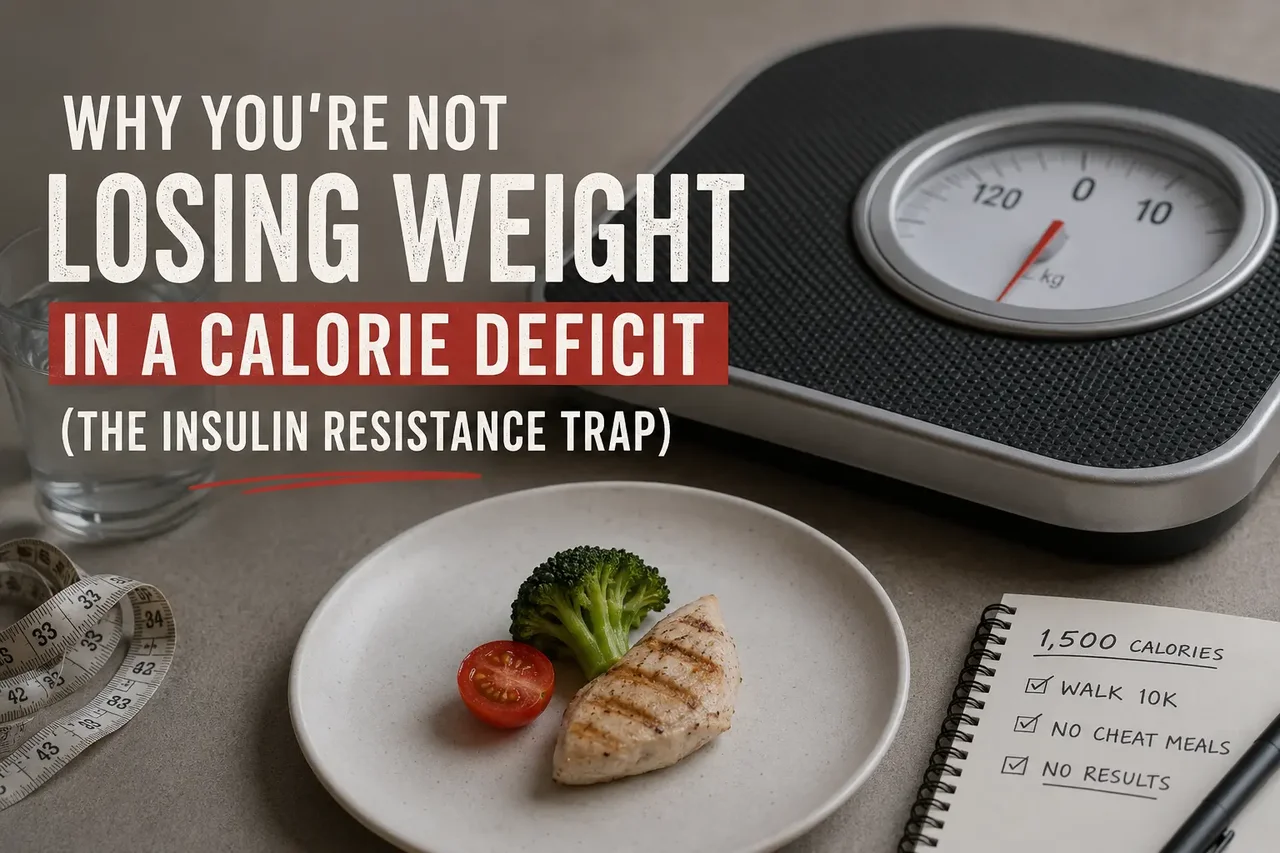
You eat 1,500 calories. You walk 10,000 steps. You've done this for weeks and the scale has barely moved — or worse, it's crept up. Every fitness influencer tells you "calories in, calories out," so you assume you're miscounting, cheating, or broken. You're probably none of those things. You're in the insulin resistance trap.
CICO is true — but it isn't the whole story
Thermodynamics holds: you do lose fat in an energy deficit. But your hormones decide how easy or brutal that deficit feels, how much of it comes from fat versus muscle, and how hard your body fights back. The master switch is insulin.
Insulin is the storage hormone
Insulin's job is to move energy out of the blood and into storage. When insulin is chronically high — driven by refined carbs, visceral fat, poor sleep, and genetics — your body is biochemically biased toward storing fat and resisting releasing it. You can be in a deficit and still feel locked.
The trap, step by step
High insulin keeps fat in storage and keeps you hungry. So a deficit leaves you ravenous and low on energy. You either cave, or you white-knuckle it while your metabolism quietly turns down to match. The deficit stops working and feels miserable at the same time. That's not weak willpower — that's a hormonal headwind.
Signs you're in it
Stubborn belly fat, an energy crash and sleepiness after meals, intense carb or sugar cravings, and sometimes darkened velvety skin around the neck or armpits (acanthosis nigricans). For Indians this is especially common because of where the body stores fat — see [the Asian Indian phenotype](/blog/asian-indian-phenotype).
How to actually check
Don't guess. Ask for fasting insulin, HOMA-IR, HbA1c, and your triglyceride-to-HDL ratio. These reveal insulin resistance long before a fasting glucose test ever calls you "diabetic."
What breaks the cycle
Prioritise protein, build muscle with resistance training, fix your sleep, and cut the refined-carb spikes that keep insulin elevated. For many people whose resistance is entrenched, GLP-1 medicines change the game — they lower insulin resistance directly and quiet the appetite signalling that makes the deficit unbearable. That same quieting effect reaches beyond food: it's [why some people stop wanting to drink](/blog/semaglutide-alcohol).
If you've been disciplined and still stuck, an ALTRcare doctor can test whether insulin resistance is the reason — and whether medication is right for you.
Frequently asked questions
If calories are all that matter, why am I not losing weight?
Calories still matter, but insulin resistance can blunt fat release and drive hunger, making a deficit harder to sustain and slower to show results. The fix usually involves addressing insulin, not just eating even less.
What test shows insulin resistance early?
Fasting insulin with HOMA-IR, plus your triglyceride-to-HDL ratio, often flag insulin resistance years before fasting glucose or HbA1c crosses into the diabetic range.
Will eating fewer calories fix insulin resistance?
It can help, but for many people protein, resistance training, sleep, fewer refined carbs — and sometimes GLP-1 therapy — address the underlying resistance more effectively than cutting calories alone.
Ready to take the next step?
Take the free 2-minute eligibility assessment. A doctor reviews it before anything is prescribed — no obligation.
This article is for general educational purposes and is not a substitute for personalised medical advice. GLP-1 medications are prescription-only and not suitable for everyone. Always consult a qualified doctor before starting, changing, or stopping any treatment.